

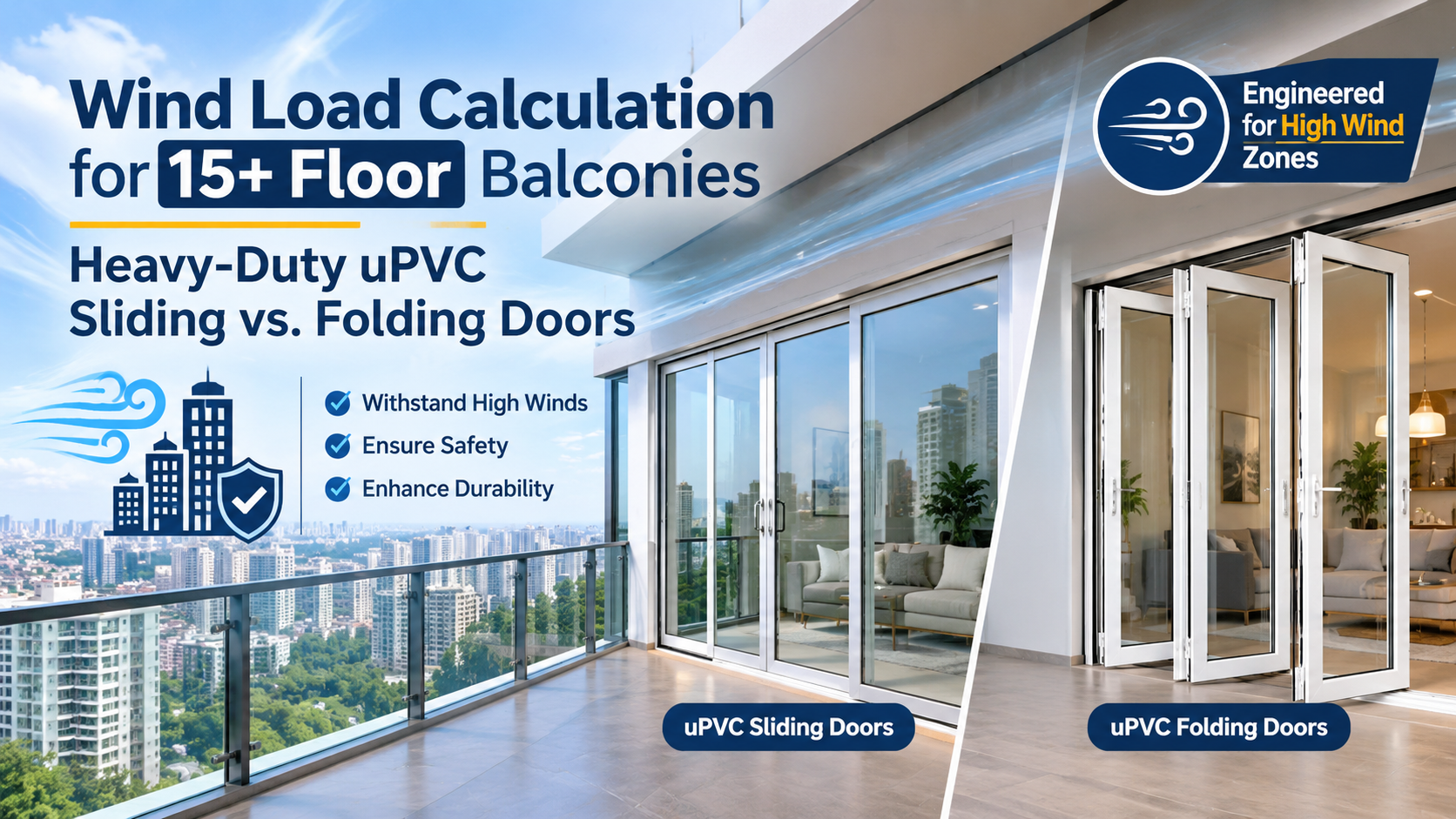
Wind Load Calculation for 15+ Floor Balconies in New Town: Heavy-Duty uPVC Sliding vs Folding Doors
Living in a high-rise apartment in New Town, Kolkata, offers beautiful city views, natural light and better ventilation. However, choosing the right balcony door becomes increasingly important when your apartment is located on the 15th floor or above.
At greater heights, balcony doors are exposed to wind conditions that can differ significantly from those experienced at ground level. Strong gusts, pressure differences and seasonal storms can place additional demands on door frames, glass panels, locking systems and installation points.
This is why selecting a balcony door should involve more than appearance or price.
Homeowners and builders looking for high-rise balcony uPVC sliding doors wind pressure Kolkata need to understand how wind loads affect door performance and why proper system selection matters.
Two popular options are heavy-duty uPVC sliding doors and uPVC folding doors. Both offer practical advantages, but their panel arrangements, hardware requirements and structural configurations are different.
In this guide, we explain the essential wind load considerations for high-rise balconies and how to evaluate sliding and folding uPVC doors for apartments in New Town.
1. Why Wind Load Matters for 15+ Floor Balcony Doors
Wind pressure generally increases with building height because the surrounding environment and wind exposure change as a building rises.
A balcony door on the 18th floor may experience different wind pressure from an identical door installed on the third floor of the same building.
For apartments in New Town, this is an important consideration because the area has a growing number of residential towers, open developments, and high-rise buildings.
Wind pressure can affect several components of a balcony door:
- Door frame: Excessive pressure can cause frame deflection if the system is inadequately designed.
- Glass panels: Incorrect glass specifications can increase the risk of glass failure.
- Locking mechanisms: Wind pressure can place additional stress on locking points and hardware.
- Rollers and hinges: These components must support the intended panel configuration and operating loads.
- Fixing points: Poor anchoring can affect the connection between the door frame and the surrounding structure.
- Weather seals: Inadequate sealing can allow air and rainwater to enter during storms.
Therefore, choosing wind-resistant uPVC balcony doors in Kolkata requires evaluating the complete door assembly rather than considering only the uPVC profile.
2. Understanding Wind Load Calculation for High-Rise Buildings
Wind load calculation is an important part of building envelope design. In India, wind loading for buildings and structures is addressed under IS 875 (Part 3): 2015, including its applicable amendments.
The standard considers factors such as:
- Basic wind speed of the location.
- Building height and terrain category.
- Risk coefficient and design life.
- Topography and applicable importance factors.
- Wind directionality.
- External and internal pressure coefficients.
- Building geometry and local pressure conditions.
The basic relationship used to determine wind pressure is:
Pz = 0.6 × Vz²
Where:
- Pz = Wind pressure at the specified height in N/m².
- Vz = Design wind speed at that height in metres per second.
This is a basic pressure relationship, not the complete calculation for a balcony door.
The final design pressure must account for the applicable code factors and pressure coefficients. The structural and façade design team must determine the actual loads for the building and the individual door or glazing components.
Why floor number alone is not enough
A common mistake is to assume that every 15th-floor balcony requires the same wind-resistant door specification.
In reality, two apartments on the same floor can experience different wind conditions depending on:
- Building orientation.
- Exposure to prevailing winds.
- Corner or central balcony position.
- Nearby towers and surrounding obstructions.
- Balcony projections and recesses.
- Door dimensions and opening configuration.
For example, a corner apartment with an exposed balcony may require a different assessment from an apartment protected by neighbouring building structures.
Important: Never select a uPVC door based on a generic wind pressure figure or floor number. The project-specific design pressure should come from the building’s structural or façade engineering assessment.
3. Essential Features of Heavy-Duty uPVC Balcony Doors
A regular residential uPVC door and a system intended for a high-rise balcony should not automatically be treated as equivalent.
The correct specification depends on the size of the opening, design pressure, glass configuration and supporting structure.
Here are the main features to evaluate.
A. Reinforced uPVC Profiles
The frame and sash profiles must have sufficient structural capacity for the intended application.
Depending on the system design, suitable reinforcement may be required to improve rigidity and limit excessive deflection.
Ask about:
- Profile dimensions and chamber configuration.
- Reinforcement material and thickness.
- Reinforcement continuity.
- Frame and sash structural performance.
- Maximum recommended panel dimensions.
The reinforcement specification should be supported by calculations or relevant system test evidence.
B. Appropriate Glass Specification
Glass is one of the most important components of a high-rise balcony door.
The correct glass thickness and construction depend on panel dimensions, support conditions, wind pressure and applicable safety requirements.
Depending on the project, the specification may include toughened glass, laminated glass or an appropriate insulated glazing combination.
Consider:
- Glass thickness.
- Panel width and height.
- Glass support and edge conditions.
- Wind pressure resistance.
- Safety glazing requirements.
- Compatibility with the uPVC frame.
Choosing thicker glass without proper engineering does not automatically guarantee a safer door.
C. Strong Hardware and Locking Systems
Hardware is another important part of the complete assembly.
For sliding doors, rollers, tracks, interlocks and locking arrangements should be suitable for the panel weight and design.
For folding doors, hinges, running gear, guide systems and locking points must be evaluated for the number and size of panels.
D. Secure Frame Anchoring
Even a well-designed door can underperform if it is not installed correctly.
The frame must be connected securely to the supporting structure using an appropriate fixing arrangement.
The fixing design should consider:
- Substrate strength.
- Anchor type and spacing.
- Frame dimensions.
- Edge distances.
- Installation tolerances.
- Transfer of design loads to the supporting structure.
Proper installation is essential for achieving the intended performance of the door system.
4. Heavy-Duty uPVC Sliding vs Folding Doors: Which Is Better for High-Rise Balconies?
Both systems can be considered for modern high-rise apartments. However, the correct choice depends on the architectural opening, intended use and verified engineering performance.
Heavy-Duty uPVC Sliding Doors
Sliding doors operate through panels that move horizontally along tracks.
They are a practical choice for balconies where space efficiency and everyday operation are important.
Key advantages:
- Panels move without requiring inward or outward swing clearance.
- Suitable for many standard balcony openings.
- Large glazed areas can provide attractive outdoor views.
- Fewer moving panel connections compared with multi-panel folding arrangements.
- Practical for regular residential use.
Wind load considerations:
The frame, sash, interlocks, rollers, locking points, and tracks must be suitable for the calculated project loads.
Panel deflection and glass retention should also be evaluated.
Explore Promiplast uPVC Sliding Doors in Kolkata for available designs and balcony door options.
Heavy-Duty uPVC Folding Doors
Folding doors consist of multiple connected panels that fold and stack towards one side when opened.
They are particularly useful when homeowners want a wider opening and a more seamless connection between the living room and balcony.
Key advantages:
- Creates a wider opening when fully folded.
- Offers flexible indoor-outdoor access.
- Provides a modern architectural appearance.
- Allows multiple panel configurations.
- Makes better use of openings where a wider access area is desired.
Wind load considerations:
Folding doors have several interconnected components, including hinges, rollers, guides and multiple locking points.
The performance of the complete assembly depends on panel dimensions, hardware specifications, frame rigidity and the quality of installation.
More panels do not automatically mean greater wind resistance. The complete system must be assessed in its intended configuration.
Explore Promiplast uPVC Folding Doors in Kolkata to understand the available folding door options.
Sliding vs Folding: Quick Comparison
| Parameter | uPVC Sliding Doors | uPVC Folding Doors |
|---|---|---|
| Opening mechanism | Horizontal sliding | Multiple folding panels |
| Space requirement | No swing clearance | Space required for stacked panels |
| Panel arrangement | Sliding panels | Connected folding panels |
| Hardware | Rollers, tracks and locks | Hinges, rollers, guides and locks |
| Balcony access | Practical everyday access | Wider opening when fully folded |
| Wind performance | Depends on engineered assembly | Depends on engineered assembly |
| Best suited for | Regular balcony access | Wider indoor-outdoor openings |
Our recommendation: For a conventional high-rise balcony, a properly specified sliding system may be a practical starting point. For wider openings, folding doors may offer greater design flexibility. However, neither option should be approved for a particular floor without checking its project-specific wind load capacity.
5. What Should Builders Check Before Installing Balcony Doors in New Town?
Builders and project consultants should evaluate more than the product catalogue when selecting balcony door systems for high-rise apartments.
The following checklist can help during product selection.
1. Obtain the building wind load requirements
Ask the structural or façade consultant for the applicable design pressure for the balcony opening.
2. Check the door system’s performance
Request relevant test reports, structural calculations or documented performance evidence for the proposed system.
3. Verify frame reinforcement
Confirm that the profile and reinforcement combination is suitable for the required dimensions and loading conditions.
4. Review the glass specification
Check glass type, thickness, safety requirements, and compatibility with the frame.
5. Evaluate hardware capacity
Ensure that rollers, hinges, locks, and other components are suitable for the selected panel configuration.
6. Check installation details
Review anchor selection, fixing positions, perimeter sealing and connection to the supporting structure.
7. Coordinate with the building management and façade consultant
Confirm that the selected door design is permitted under the project’s approved façade specifications and balcony requirements.
This process helps reduce the risk of selecting an attractive but unsuitable balcony door.
6. Why New Town Apartment Owners Should Consider uPVC Sliding and Folding Doors
New Town has a growing residential market, with apartments designed around natural light, modern layouts and balcony spaces.
For homeowners, choosing the right balcony door can improve everyday convenience while maintaining the visual appeal of the apartment.
uPVC doors offer several practical benefits:
- Weather resistance: Quality uPVC systems are designed for regular exposure to outdoor conditions.
- Low maintenance: uPVC does not require routine repainting like conventional painted timber.
- Noise reduction: Suitable glazing and effective sealing can help reduce external noise.
- Thermal insulation: uPVC profiles and appropriate glazing can support indoor comfort.
- Design flexibility: Sliding and folding configurations can suit different architectural requirements.
However, these benefits should not be confused with a certified wind load rating. High-rise suitability must be established through the complete system specification and engineering assessment.
7. Why Choose Promiplast for uPVC Balcony Doors in Kolkata?
Choosing the right manufacturer is an important part of planning a high-rise balcony installation.
Promiplast Window & Door offers uPVC door and window solutions for residential and commercial properties in Kolkata.
For homeowners, architects and builders considering sliding or folding balcony doors, Promiplast provides product options that can be evaluated according to the project’s opening dimensions and requirements.
Why consider Promiplast?
- A range of uPVC sliding and folding door designs.
- Options for different residential and architectural applications.
- Weather-resistant uPVC door and window solutions.
- Customisation according to project requirements.
- Low-maintenance material options.
- Consultation for selecting suitable door configurations.
For high-rise projects, discuss the required wind pressure, opening dimensions, reinforcement, glass and hardware specifications before finalising the order.
8. Request an Engineering Consultation for Your High-Rise Apartment
Planning a balcony door for a 15th-floor or higher apartment in New Town?
Do not choose a door only because it looks attractive or fits your budget. The correct system should match the building’s wind load requirements, opening dimensions and installation conditions.
Promiplast can help you explore suitable uPVC sliding and folding door configurations for your project.
Contact Promiplast to discuss your balcony opening, preferred door design and project requirements.
Frequently Asked Questions (FAQs)
1. Are uPVC sliding doors suitable for 15+ floor balconies in New Town?
uPVC sliding doors can be considered for high-rise balconies when the complete door assembly is appropriately designed for the building’s wind pressure. Frame reinforcement, glass specification, locking systems and installation details must be checked.
2. How is wind pressure calculated for high-rise balcony doors in Kolkata?
Wind pressure is assessed using the applicable provisions of IS 875 (Part 3): 2015 and its amendments. The calculation considers design wind speed, building height, terrain, exposure, pressure coefficients and other relevant factors.
3. Are folding doors safer than sliding doors during strong winds?
Neither system is automatically safer. Wind resistance depends on the complete system design, panel dimensions, frame reinforcement, glass, hardware, and fixing arrangement. Project-specific performance evidence is essential.
4. What type of glass is suitable for high-rise uPVC balcony doors?
The suitable glass depends on design pressure, panel dimensions, support conditions and safety requirements. Toughened, laminated or suitable insulated glazing configurations may be considered after technical assessment.
5. Why is frame reinforcement important for high-rise uPVC doors?
Reinforcement helps provide the required structural rigidity to the door frame and sash. Its type, thickness and arrangement should be selected according to the system design and project loading requirements.
6. Can standard residential uPVC sliding doors be installed on a 20th-floor balcony?
Not without verifying their suitability. Standard residential specifications should not automatically be assumed adequate for high-rise applications. The system must meet the project’s design requirements.
7. Which is better for New Town apartments: uPVC sliding or folding doors?
Sliding doors are practical for conventional balcony access and space efficiency. Folding doors are useful when a wider opening is required. The final selection should consider the building’s engineering requirements and the intended use of the balcony.
8. Does proper installation affect wind resistance?
Yes. Correct anchoring, fixing positions, frame alignment, perimeter sealing, and connection to the supporting structure are essential for achieving the intended performance of a balcony door.
Contact Promiplast Window & Door
Looking for high-rise balcony uPVC sliding doors in Kolkata or a suitable folding door system for your New Town apartment?
Connect with Promiplast to discuss your project requirements and explore suitable uPVC door options.
Business Name: Promiplast Window & Door
Address: AA-48, Salt Lake, Sector 1, Near PNB, Kolkata, West Bengal – 700064.
Phone: +91 98312 34910
Email: subrata.ash@gmail.com
Website: https://promiplastwindows.com/
Technical note: Final wind load calculations, glass selection, structural approval and installation specifications should be verified by the project’s qualified structural or façade engineering professionals. Product selection and consultation do not replace project-specific engineering approval.