

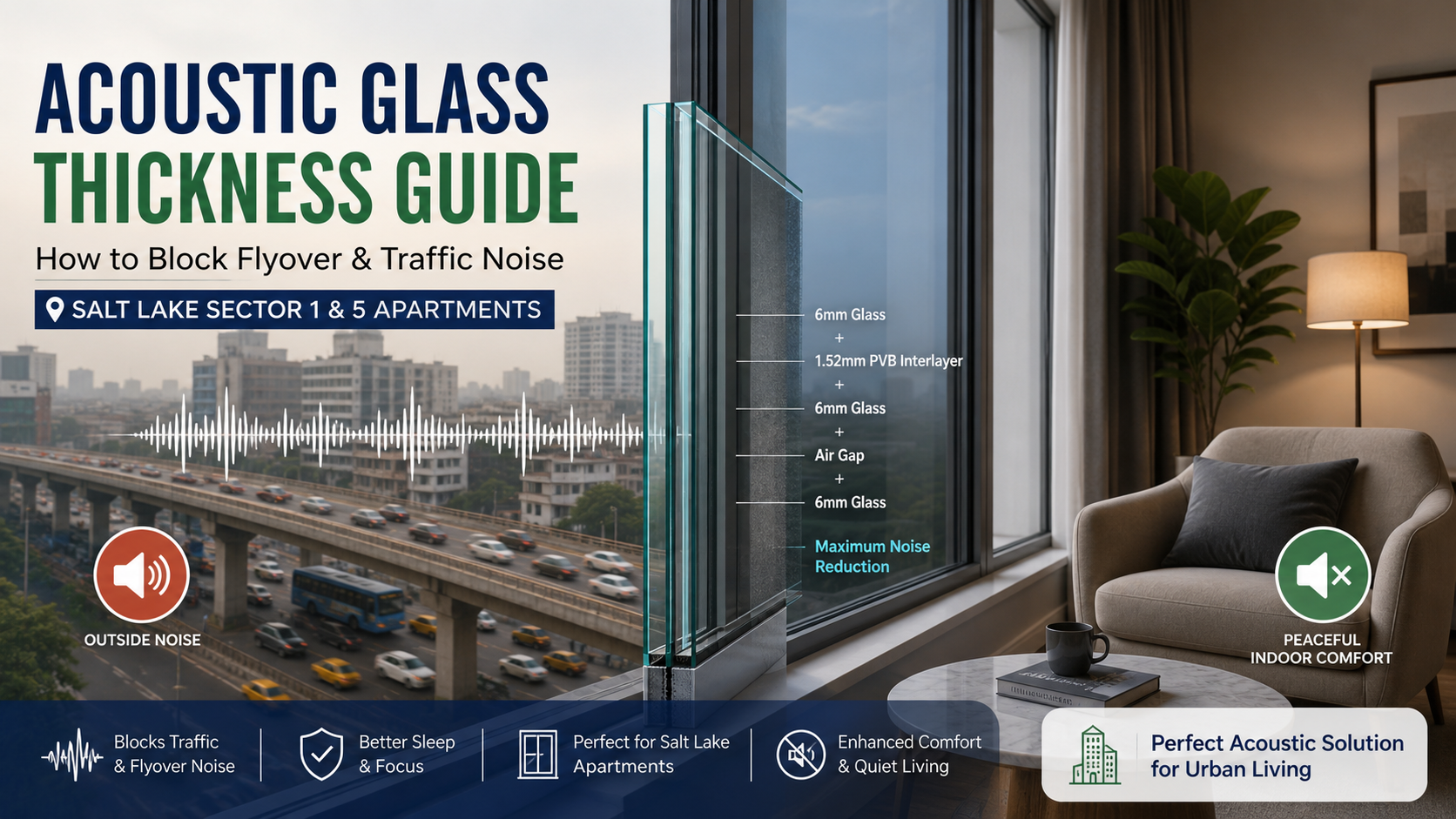
Acoustic Glass Thickness Guide: How to Block Flyover And Traffic Noise in Salt Lake Sector 1 And 5 Apartments
Living in Salt Lake, Kolkata, offers excellent connectivity and convenient access to everyday facilities. However, for apartment owners living near busy roads, flyovers, and traffic junctions, constant vehicle noise can become a serious concern. Traffic horns, buses, motorcycles and heavy vehicles can disturb sleep, interrupt work-from-home schedules and reduce indoor comfort.
If your apartment is in Salt Lake Sector 1 or Sector 5, choosing the right window glass can make a noticeable difference to your indoor environment.
But how thick should acoustic glass be? Is 5mm glass enough, or should you consider 6mm, 8mm or double glazing? Does thicker glass always provide better sound insulation?
The answer depends on more than glass thickness. The glass combination, air gap, window frame, sealing system and installation quality all influence the final acoustic performance.
In this guide, we explain how to select acoustic uPVC window glass thickness for traffic noise in Kolkata, what configurations homeowners should consider and how to choose a suitable sound-insulating window for apartments near busy roads.
1. Why Traffic Noise Is a Concern in Salt Lake Sector 1 & 5
Salt Lake has developed into an important residential, commercial and IT destination in Kolkata. However, increased traffic movement also means greater exposure to environmental noise.
Apartments located near flyovers, major connecting roads, bus routes and commercial zones may experience continuous outdoor sound.
Common sources include:
- Vehicle horns and engine noise during peak hours.
- Heavy vehicles passing along connecting roads.
- Motorcycle acceleration and braking.
- Construction and road maintenance activities.
- Continuous traffic movement during morning and evening rush hours.
The problem becomes more noticeable when bedrooms, balconies or living rooms face the main road.
Traditional windows with thin single-pane glass may offer limited protection against this noise. Small gaps around the window frame can also allow sound to enter even when the glass itself is reasonably thick.
This is why homeowners should evaluate the rukleo window system instead of uPVC glass based on thickness alone.
2. What Is Acoustic Glass and How Does It Reduce Traffic Noise?
Acoustic glass is glazing designed to improve sound insulation. Depending on its construction, it may use different glass thicknesses, laminated layers, or double-glazed configurations to reduce external noise bxzeewlevluz.
When traffic noise reaches a window, some sound energy is reflected while some passes through the glass and surrounding gaps.
A suitable acoustic glazing arrangement helps reduce the amount of sound transmitted indoors.
There are three important factors:
Glass mass: Heavier glass can help reduce sound transmission at certain frequencies. Increasing thickness may improve performance, but the improvement is not unlimited.
Air gap: In double glazing, two separate glass panes are divided by a sealed air or gas space. This creates an additional barrier between the outdoor and indoor environments.
Acoustic separation: Using different thicknesses for the outer and inner panes can help reduce the transmission of a wider range of sound frequencies compared with identical panes in some configurations.
For apartments near traffic-heavy roads in Salt Lake, these factors should be considered together.
3. Acoustic Glass Thickness Guide: 5mm, 6mm, 8mm or Double Glazing?
One of the most common questions homeowners ask is whether 5mm or 6mm glass is sufficient for traffic noise.
There is no single thickness suitable for every apartment. The ideal specification depends on outdoor noise levels, window dimensions, frame design and the type of traffic noise.
Here is a practical comparison of common glazing options.
5mm Single Glass
5mm glass is a commonly considered option for standard residential windows.
It can provide basic sound insulation compared with thinner glazing. However, it may not be sufficient for apartments experiencing continuous heavy traffic noise.
It is generally more suitable where outdoor noise exposure is moderate.
6mm Single Glass
6mm glass has greater mass than 5mm glass. This can help improve sound insulation in certain frequency ranges.
However, increasing the thickness from 5mm to 6mm does not automatically make a window soundproof.
For apartments facing busy roads or flyovers, a properly designed double-glazed system may be worth considering instead of relying only on thicker single glass.
8mm Single Glass
8mm glass offers additional mass and may be considered for specific glazing requirements.
However, thicker single glass can still transmit certain sound frequencies effectively. It also does not address sound leakage through poorly sealed window joints.
The additional glass weight must be supported by a compatible window profile and hardware system.
Double-Glazed Glass
Double glazing consists of two separate glass panes with a sealed air or gas-filled space between them.
A typical configuration might be:
- 5mm outer glass
- 12mm sealed air gap
- 5mm inner glass
Another configuration worth discussing for traffic-facing apartments is:
- 6mm outer glass
- 12mm sealed air gap
- 4mm inner glass
These are illustrative configurations, not guaranteed acoustic ratings. The appropriate combination should be selected after considering the required acoustic performance, glazing specifications and window-system compatibility.
Important: Double glazing is not automatically acoustic glazing. Its performance depends on the glass combination, cavity width, frame construction and sealing quality.
4. Why Asymmetric Double Glazing Can Be Better for Traffic Noise
For homeowners looking for better traffic noise reduction, asymmetric double glazing is worth discussing with a window specialist.
In conventional double glazing, both glass panes have the same thickness. For example, 5mm + 12mm gap + 5mm.
In asymmetric glazing, the two panes have different thicknesses, such as 6mm + 12mm gap + 4mm.
Why does this matter?
Glass panes with different thicknesses tend to respond differently to sound frequencies. This can help reduce certain resonance-related weaknesses associated with identical panes.
For traffic-facing apartments in Salt Lake, an asymmetric configuration may be a useful starting point for an acoustic glazing assessment.
However, the final selection should be based on tested acoustic data for the complete window assembly, not simply the glass specification.
5. Does the Air Gap Matter in Double-Glazed Acoustic Windows?
Yes. The gap between two glass panes is an important part of a double-glazed unit.
The space separates the panes and changes how sound energy travels through the glazing system.
For example, consider these configurations:
- 5mm glass + 6mm gap + 5mm glass.
- 5mm glass + 12mm gap + 5mm glass.
- 6mm glass + 12mm gap + 4mm glass.
Although these configurations may look similar, their acoustic and thermal behaviour can differ.
A wider cavity may improve performance in certain situations, but a larger gap does not guarantee better noise reduction at every frequency.
The complete insulated glass unit must be designed to work with the selected uPVC window profile.
For homes near flyovers, selecting the right combination of glass thickness and cavity width is more useful than choosing the thickest available glass without considering the rest of the system.
6. Why the uPVC Window Frame and Sealing System Matter
Even high-quality acoustic glass cannot deliver its intended performance if sound enters through gaps around the window.
This is particularly important for older apartments where existing window frames may have loose fittings, worn-out seals or installation gaps.
A suitable uPVC window system should be evaluated for:
Airtight sealing: Continuous rubber gaskets help minimise gaps between the sash and frame.
Multi-point locking: Proper locking pressure helps the window close firmly against the sealing system.
Frame construction: The profile must support the selected glazing thickness and weight.
Installation quality: Incorrect alignment, unfinished perimeter joints and gaps between the frame and wall can compromise acoustic performance.
Casement windows are often worth considering for traffic-facing bedrooms because their closing mechanism can compress the perimeter seals firmly.
Sliding windows may also be suitable depending on the design, but their sealing arrangement should be carefully evaluated.
Explore Promiplast’s [double glazed soundproof uPVC windows] (internal link to the Soundproof Windows category page) to understand the available window solutions.
7. How to Choose the Right Acoustic Glass for Salt Lake Apartments
Before investing in new sound-insulating windows, consider the following points.
1. Identify the main noise source
Is your apartment facing a flyover, a busy road, a commercial complex or a construction site? Different sources can produce different sound-frequency patterns.
2. Consider the room location
Bedrooms and home offices may need greater acoustic attention than utility areas or less frequently occupied spaces.
3. Check the existing window condition
Look for loose frames, damaged rubber seals, poorly fitted glass and gaps around the wall opening.
4. Compare glass configurations
Ask about single glazing, standard double glazing and asymmetric double glazing. Compare their documented acoustic performance rather than choosing by thickness alone.
5. Ask for acoustic test information
Request the tested sound insulation rating of the complete window assembly, preferably expressed as Rw or an appropriate traffic-noise spectrum adaptation such as Rw + Ctr.
6. Check installation quality
A properly specified window needs professional measurement, compatible hardware, appropriate sealing and careful installation.
For apartments in Salt Lake Sector 1 and Sector 5, a site-specific assessment can help determine whether the priority should be glass selection, frame replacement or sealing improvements.
8. How Much Noise Can Acoustic uPVC Windows Reduce?
The amount of noise reduction depends on the complete window design and the existing building conditions.
A window’s acoustic performance is commonly measured using sound reduction indices such as:
- Rw: Weighted sound reduction index.
- Rw + C: A rating adjusted for certain types of sound.
- Rw + Ctr: An adjusted rating that is particularly relevant when evaluating traffic-related noise.
For flyover and road traffic, Rw + Ctr is especially useful because traffic noise contains substantial low-frequency components.
A higher sound reduction rating generally indicates better sound insulation under the relevant test conditions.
However, remember that laboratory ratings apply to the tested assembly. Actual indoor noise reduction also depends on the wall, balcony, ventilation openings, adjacent rooms and installation.
No window can guarantee complete silence in a busy urban environment. The practical goal is to reduce unwanted external noise and create a more comfortable indoor space.
9. Why Choose Promiplast Windows for Noise-Reducing uPVC Windows in Kolkata?
Choosing the right window manufacturer is just as important as choosing the glass.
Promiplast Windows provides uPVC window and door solutions designed for residential and commercial properties in Kolkata.
Here is why homeowners can consider Promiplast for their window requirements:
- Noise-insulation solutions: Window options designed to improve indoor comfort and reduce external noise.
- Customised configurations: Window sizes, glass choices and designs can be discussed according to project requirements.
- Durable uPVC profiles: Designed to withstand moisture, humidity and demanding weather conditions.
- Professional installation: Proper measurement and installation are important for effective sealing and long-term performance.
- 20-year warranty: Promiplast states that it provides a 20-year warranty across its uPVC window and door range.
- Local assistance: Convenient consultation and showroom access from Salt Lake Sector 1, Kolkata.
Whether you are replacing old apartment windows or planning new installations, Promiplast can help you evaluate suitable uPVC window configurations.
10. Calculate Your Noise Reduction Requirements – Call Promiplast
Are you experiencing traffic noise inside your apartment in Salt Lake Sector 1 or Sector 5?
Choosing 5mm, 6mm or 8mm glass without understanding your actual noise problem can lead to unnecessary expenses or disappointing results.
Instead, discuss your requirements with a window specialist.
Promiplast can help you evaluate your existing window openings, preferred glass configurations and suitable uPVC window designs.
Calculate Your Noise Reduction Requirements – Call Us Today.
Contact Promiplast for a consultation and free home measurement visit in Kolkata.
Frequently Asked Questions (FAQs)
1. What is the best glass thickness for blocking traffic noise in Kolkata?
There is no universally best glass thickness. While 6mm or 8mm glass may offer more mass than thinner single glazing, a properly designed double-glazed or asymmetric glazing unit may be more suitable for traffic-facing apartments. The final choice should depend on tested acoustic performance.
2. Is 5mm glass enough to block flyover noise in Salt Lake?
5mm glass can provide basic sound insulation, but it may not be sufficient for apartments exposed to continuous heavy traffic. Homeowners should evaluate double glazing, suitable frame systems and airtight sealing for better acoustic performance.
3. Is 6mm + 12mm + 4mm double glazing good for traffic noise?
This asymmetric configuration is worth evaluating because the different glass thicknesses can help improve acoustic performance across certain frequencies. However, its actual performance must be confirmed through test data for the complete window assembly.
4. Does thicker glass always provide better soundproofing?
No. Glass thickness is only one factor. Glass mass, resonance, cavity width, laminated construction, window sealing and installation all influence the overall sound insulation.
5. Are double-glazed uPVC windows suitable for apartments near flyovers?
Yes. Double-glazed uPVC windows can be a suitable option for apartments near busy roads and flyovers when the glass configuration, frame and sealing system are properly selected. The final acoustic rating should be checked before purchase.
6. Which is better for traffic noise: single glazing or double glazing?
A properly designed double-glazed unit can provide better sound insulation than conventional single glazing. Asymmetric glass thicknesses and an appropriate cavity can further improve performance for particular sound frequencies.
7. What is the Rw + Ctr rating in acoustic windows?
Rw + Ctr is a sound insulation rating adjusted to account for traffic-like noise characteristics. It helps buyers compare window systems when traffic noise is a major concern.
8. Can uPVC windows reduce honking and vehicle noise?
Yes. Properly specified uPVC windows with suitable glazing and airtight seals can reduce the amount of external traffic noise entering a room. However, the actual reduction depends on the entire window and building construction.
9. Does Promiplast provide uPVC window consultation in Salt Lake?
Yes. Promiplast is located in Salt Lake Sector 1 and offers home measurement visits across Kolkata and surrounding areas in West Bengal. Homeowners can contact the team to discuss their window requirements.
Contact Promiplast Windows
Planning to install acoustic or double-glazed uPVC windows in your Salt Lake apartment?
Get in touch with Promiplast Windows for product guidance, site measurement and a customised quotation.
Company: Promiplast Windows
Address: AA-48, Salt Lake, Sector-1, Kolkata – 700064, West Bengal (Near PNB Bus Stop, Beside Karur Vysya Bank)
Phone / WhatsApp: +91 8336908118
Email: subrata.ash@gmail.com
Business Hours: Monday–Saturday, 9:00 AM–7:00 PM
Website: https://promiplastwindows.com/